
GPT-5.6: Three Models. Three Roles. One Knowledge-Work System.
The real advantage isn't choosing the smartest model—it's knowing which model to use at each stage of the work.

I’m starting to see AI models less as competitors and more as different stages in a knowledge-work operating system.
This is not a comparison of software-engineering performance. I’m not talking about hard coding. My use case is building frameworks, skills, workflows, and repeatable systems for daily knowledge work.
The best model may depend on the maturity of the work.
In that context, I’ve found myself using GPT-5.6 in three distinct ways.
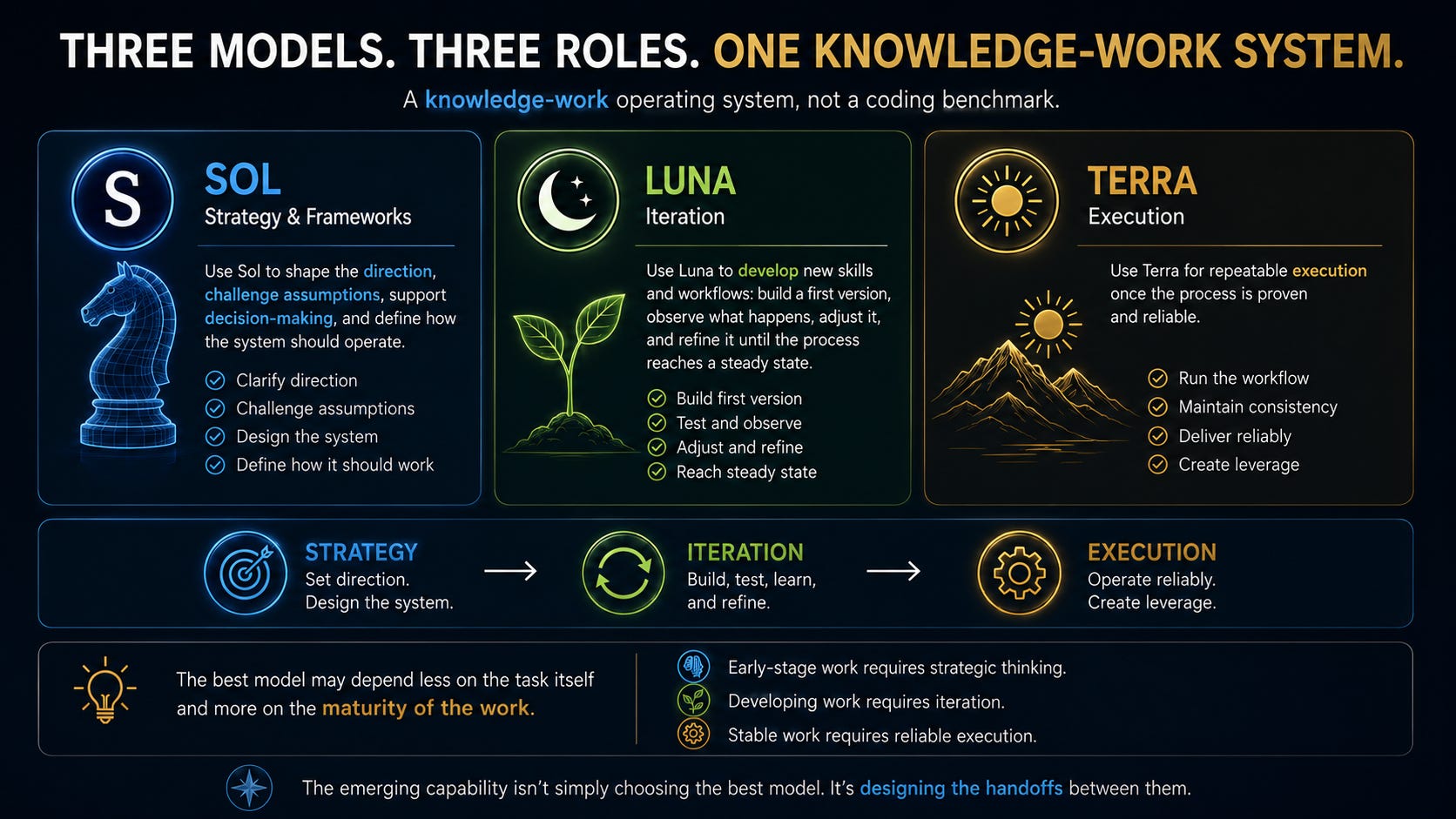
Sol for strategy and frameworks
I use Sol when I’m trying to understand the underlying problem, challenge assumptions, make decisions, and define how a system should work.
Shape the direction before building the system.
This is the stage where the direction is still being shaped.
The output is not just an answer. It is the framework that will govern everything that comes next.
Luna for iteration
Once the direction is clear, I move the work to Luna.
This is where I build the first version of a skill or workflow, observe what happens, make adjustments, and continue refining it.
Build. Observe. Adjust. Refine.
The goal is not immediate perfection. The goal is to move the work toward a steady state where the process is understood, reliable, and repeatable.
Terra for execution
Once the workflow is stable, the nature of the work changes.
It no longer needs the same level of exploration. It needs consistent execution.
Once the workflow is stable, consistency creates leverage.
That is where I use Terra: running the workflow, maintaining consistency, and creating leverage through repetition.
The work changes as it matures
The simple model is:
Strategy → Iteration → Execution
What I find interesting is that the best model may depend less on the task itself and more on the maturity of the work:
Early-stage work requires strategic thinking.
Developing work requires iteration.
Stable work requires reliable execution.
The models will continue to evolve, so I would not treat these assignments as permanent. But the larger principle feels durable.
The emerging capability is designing the handoffs between models.
My thoughts on how to operationalize Principles in your daily work.

The emerging capability is not simply choosing the best model.
It is designing the handoffs between them.
Want AI that works reliably in real work?
I write practical field notes on Governed Autopilot, AI workflows, prompt systems, and solo-operator leverage.
Subscribe free to get the next one.
You can also browse the full essay library here: promptivity.ai/essays