
Principles Are Not Notes. They Are Operating Context.
How I govern ChatGPT memory so it supports judgment instead of replacing it.

I used to think principles were something you wrote down.
Now I think they are something you deliberately build into the systems you use to think.
A lesson only becomes useful when it becomes reusable.
Most lessons do not disappear because they were unimportant. They disappear because they stayed as notes, thoughts, or things I once agreed with but never turned into judgment.
That matters more now because I use ChatGPT as a cognitive thinking partner.
Not something that thinks for me.
Something I think with.
And if I am going to use it that way, context matters.
But not all context deserves memory.
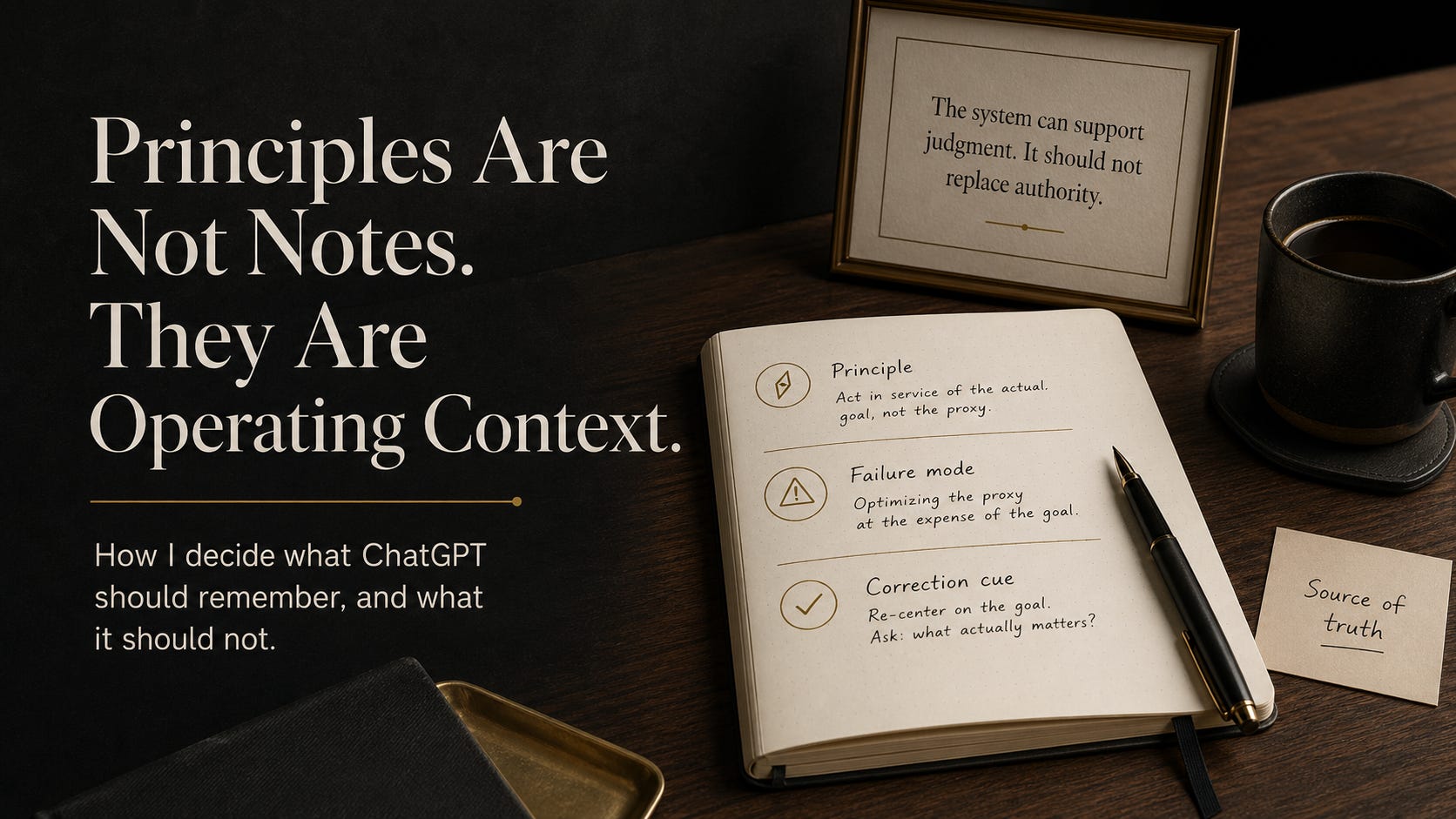
Principles are reusable judgment
Ray Dalio helped make the language of principles familiar: reusable rules for decision-making.
I have always liked that idea because it turns experience into something more durable than reflection.
But in the AI age, principles can do more than sit in a notebook.
They can become operating context.
A principle is not just something I believe. It is something I want to shape future judgment.
That is the shift.
A note records what I noticed.
A principle governs how I want to think.
Memory is the influence
ChatGPT memory is not just a place where information sits.
It can shape future responses. It can affect tone, emphasis, assumptions, and recommendations.
That is useful.
It is also risky.
Because a cognitive thinking partner needs context, but not every detail deserves to be carried forward.
Memory is not where I store everything I want ChatGPT to know. It is where I govern what deserves to influence future thinking.
If memory becomes storage, it turns into clutter.
Old preferences. Abandoned projects. Stale assumptions. Random facts. Half-true versions of who I used to be.
The danger is not only that ChatGPT forgets something.
The deeper danger is that it remembers the wrong thing too confidently.
Bad memory is stale context with too much authority.
That is why I do not treat memory as automatic.
Governed memory
I have a formal Memory Control Policy for how I store and manage memories in ChatGPT, which includes monthly, quarterly, and annual reviews.
I am not going to publish the whole thing here, because the point is not the policy.
The point is the posture.
Memory should be intentional.
Memory should be maintained.
Memory should be accountable.
Governed memory simply means memory I intentionally choose and maintain.
Not everything useful is durable. Not everything true belongs in memory.
It means I do not save everything.
It means I ask whether something deserves to shape future thinking before I let it become part of the context.
How a lesson becomes a principle
The structure I use is simple:
Principle: the rule I want carried forward.
Failure mode: the mistake I am trying to avoid.
Correction cue: the reminder that brings me back when I drift.
That structure matters because it does more than capture an insight.
It protects against drift.
Here is the principle at the center of how I think about memory:
Principle: Memory should influence behavior, not override the source of truth.
Failure mode: Better memory can create confident context drift when old or cross-domain context is applied as fact.
Correction cue: Ask what the source of truth is before letting memory shape the answer.
That is the whole game.
The plain-English version: Memory is not where you store everything you want ChatGPT to know. Memory is where you govern what deserves to influence future thinking.
Human authority stays in charge
This is why I actively govern memory: not so ChatGPT knows more about me, but so context stays useful without becoming stale or wrong.
A principle should guide thinking, not become autopilot.
AI can help me think, write, test ideas, and see patterns, but I decide what matters, what gets stored, what gets retired, and what the source of truth is.
The system can support judgment. It should not replace authority.
That is why principles are not notes.
They are choices I carry forward, deliberately.
I do not want memory to be automatic. I want it to be actively governed.
Interesting... Thanks.