
Governed Autopilot Part 4: Building the Governed AI Cockpit With OpenClaw
The model provides intelligence. OpenClaw provides the harness. My governance architecture keeps authority with the human.

TL;DR: OpenClaw gave my AI system memory, tools, continuity, and the ability to act. But capability alone was not enough. I needed an operating architecture that lets routine work flow, pauses at real consequence boundaries, and earns trust through visible evidence.
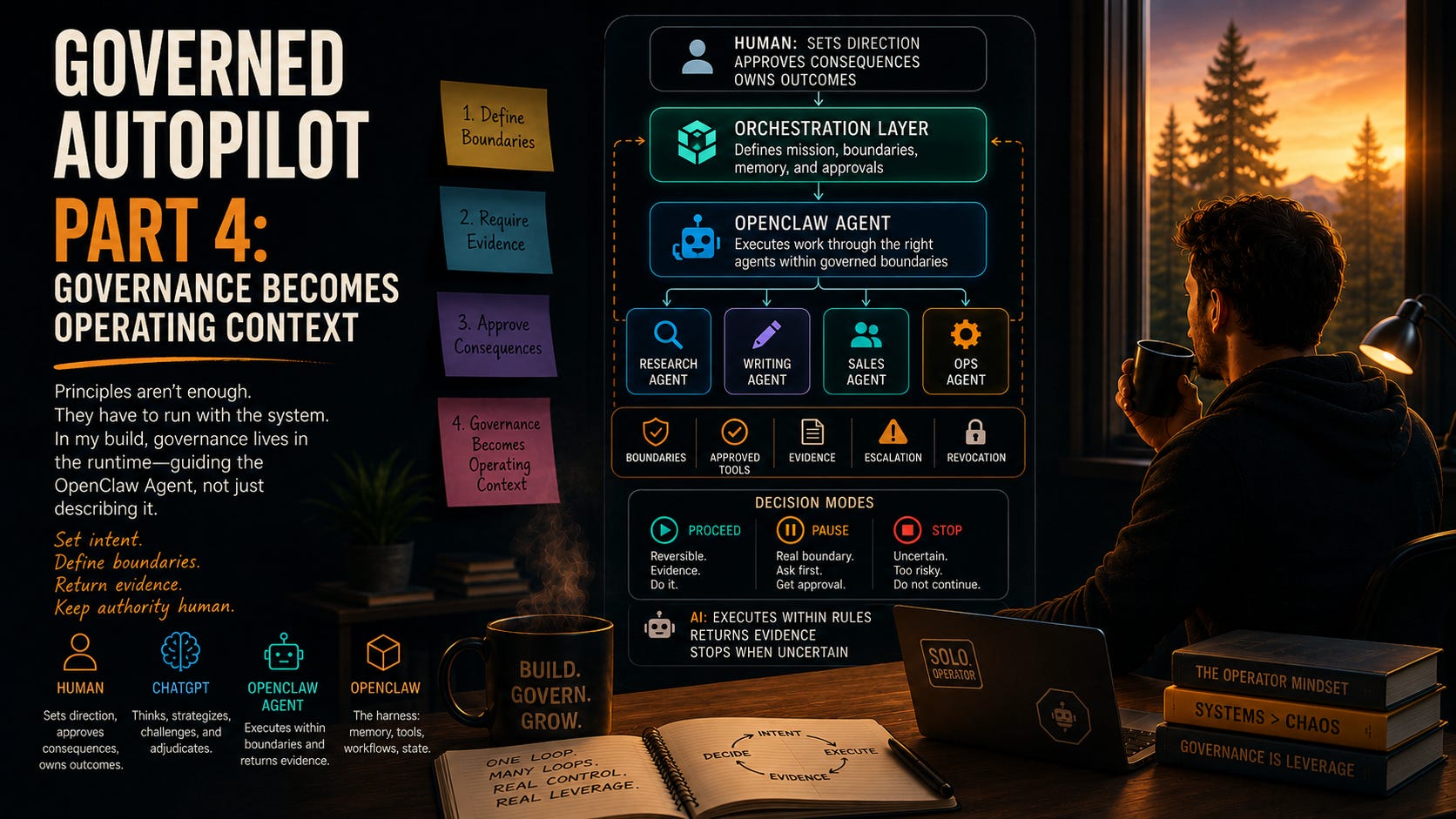
A smarter model was not the missing piece
As AI becomes more capable, it is easy to assume intelligence is the main constraint.
That was not the problem I encountered.
The difficult part was deciding when the system’s work should be trusted, what it could do without asking, and where human judgment had to remain decisive.
Real work creates consequences. Files can be changed. Messages can be sent. Money can move. Permissions can widen. Memory can become durable. A system can recover from an error, or it can make the error worse.
A smarter model does not resolve those questions.
The missing piece was an operating architecture.
OpenClaw gave AI a harness
A model can answer questions. A harness gives it continuity and reach.
OpenClaw gave me a persistent environment where an Agent could work with files, tools, memory, workflows, logs, and local services. It made it possible to move beyond a single chat session and begin building something closer to an operating system for AI-assisted work.
That changed the question.
It was no longer simply, “What can the model do?”
It became, “How should the system decide what it may do, what it must show, and when it must stop?”
OpenClaw provided the harness. The governance architecture turned it into a cockpit.
Capability and authority had to be separated
The first principle was simple:
Capability is not authority.
My thoughts on how to operationalize Principles in your daily work.

A tool can exist on a machine without the Agent having unrestricted permission to use it. A connection can be technically available without being approved for live execution.
This distinction matters because governance should not make routine work painful.
If every file inspection, log check, validation step, or recoverable action requires approval, the system creates more drag than leverage. But if every available capability is treated as permission, the system becomes unsafe by default.
The answer is to govern consequence.
Routine, local, reversible work should flow. External, financial, irreversible, permission-changing, or authority-changing work should remain under human control.
Lightweight operation. Firm boundaries. Visible evidence.
Governance became the operating context
I did not want these ideas to remain a philosophy written beside the system. I wanted them translated into the system itself.
So I created a lean governance stack:
First Principles defines why the system exists and the assumptions it must not violate.
The Governed Autopilot Vision defines the intended operating model.
The Operating Rules define the concrete runtime boundaries.
The canonical versions live in an Operations Vault in Obsidian. The runtime files contain concise translations of the relevant rules, along with direct pointers back to the source material.
The agent is not allowed to modify its runtime files directly.
Runtime changes go through a reviewable Runtime Translation Workflow. I approve the target, the wording, and the final lock-in action.
That boundary is encoded into the governance and operating rules. I remain the authority layer. I own the goals, permissions, risk acceptance, financial decisions, external commitments, canonical changes, and final acceptance.
The OpenClaw Agent serves as the governed execution layer.
It runs bounded workflows, manages routine local work, preserves context, and returns evidence. OpenClaw provides the persistent execution environment.
The governance documents are not paperwork sitting beside the build. They are part of the agent’s memory and authority infrastructure.
(More on the agent’s fully Governed Memory Architecture in a future post …..)
The cockpit runs on three states: Proceed, Pause, and Stop
The runtime needed a simple decision model. Not a policy manual in the middle of every task. Just three clear states.
Proceed is the execution state.
Proceed applies when work is local to the OpenClaw environment, inside an approved scope, reversible or recoverable, and supported by visible evidence.
The agent should do the work, preserve the record, and report what changed.
Pause is the authority state.
Pause applies when work reaches a real consequence boundary or when authority is unclear.
That includes external exposure, money, secrets, new credentials, broader permissions, durable memory, canonical governance changes, irreversible action, or a new way for the system to affect the world beyond its normal environment.
In Pause, the agent should not keep improvising. It should return a decision packet.
Stop is the safety state.
Stop applies when continuing could compound harm: validation fails, failures repeat, rollback confidence is weak, instructions conflict, the system cannot explain what changed, or the next step could make recovery harder.
In Stop, the agent should preserve evidence, avoid further action, and return the smallest useful recovery or escalation packet.
Good governance does not require the human to approve every operating step. It requires the system to recognize which steps carry consequence.
When a boundary appears, the agent should return the smallest useful decision packet: the requested action, why it matters, the risk, the rollback or disable path, and the exact approval it needs.
That preserves leverage without surrendering authority.
It also reduces cognitive friction because the operator does not have to supervise routine work. Human attention is reserved for judgment.
Evidence is how the cockpit earns trust
The OpenClaw Agent should not earn trust because it sounds confident.
The Agent should earn trust by making its work inspectable.
After meaningful execution, the cockpit should show what the system attempted, what governed the action, what changed, what remains uncertain, and how the result can be reversed or disabled.
This becomes more important as work grows longer-running, scheduled, or distributed across multiple workflows and delegated agents. Hidden state creates hidden risk. Logs, summaries, diffs, and readable records make the work recoverable and reviewable.
But visibility alone is not enough.
Real work rarely has a perfect benchmark. Many decisions involve tradeoffs, incomplete information, reputation, money, or delayed consequences. The system may show what it did without proving that the result deserves acceptance.
That is where human judgment remains essential.
Over time, the agent may identify friction, propose improvements, and test changes inside a bounded environment through properly governed learning loops. But it should never silently widen its permissions, promote its own rules into canonical authority, or redefine what it is allowed to become.
Improvement can be automated. Authority cannot.
From personal build to Promptivity architecture
This is where Promptivity starts moving from essays into architecture.
The OpenClaw build is now a testbed for a larger idea:
Solo operators and small businesses need more leverage from AI, but they do not need blind autonomy or enterprise governance theater.
They need right-sized governance.
They need systems that can handle routine work without constant interruption, preserve context beyond a chat window, return evidence, recognize real boundaries, recover from failure, and escalate the decisions that still belong to a human.
That may eventually become a product surface: cockpit patterns, governance templates, runtime rules, evidence protocols, decision packets, implementation kits, or governed workflow systems.
Two articles on where fully autonomous breaks down, at least for now.


But the architecture has to be proven before it is packaged.
That is what this OpenClaw build is doing.
The model provides intelligence. OpenClaw provides the harness. The Agent provides bounded execution. ChatGPT helps with strategy and adjudication. The governance architecture keeps authority with the human.
Evidence determines whether the work earns trust.
That is the cockpit I am building.
Governed Autopilot will continue to document the build. Promptivity will turn the proven patterns into an architecture others can use.
Want AI that works reliably in real work?
I write practical field notes on Governed Autopilot, AI workflows, prompt systems, and solo-operator leverage.
Subscribe free to get the next one.
You can also browse the full essay library here: promptivity.ai/essays
You’ve articulated what I’ve come to my own harness creation attempts. It feels like that visibility layer is really important to align the human and ai mind. For me the structure of a project needs to be actually visible (preferably in charts, tables, graphs, etc). To trust that the AI is going down the right path I have built a sort of dashboard including links to the most important documents in the project, what was recently completed, key metrics, and the MINS (most important next step). With all this we are starting to track well together.
I wonder how long it will be before the labs figure out that this trust layer is an important part of their product and we see consumer versions of these more mature systems.