
The Work Is Not the Workflow
Why AI workflows need tacit knowledge and fail without domain expertise

People are using AI to summarize meetings, draft emails, create proposals, build slides, write updates, and automate their workflows.
A lot of the output looks clean.
That is the trap.
Clean is not the same as useful. Professional is not the same as accurate. A workflow can follow every visible step and still miss the actual work.
People who understand the work can see the gap immediately.
The missing layer is often not more AI capability. It is tacit knowledge: what an expert notices, judges, avoids, sequences, and adjusts through experience.
AI workflows fail when they automate visible task steps but miss the hidden judgment behind the work. Reliable AI depends on domain experts translating that judgment into reusable prompt workflows.
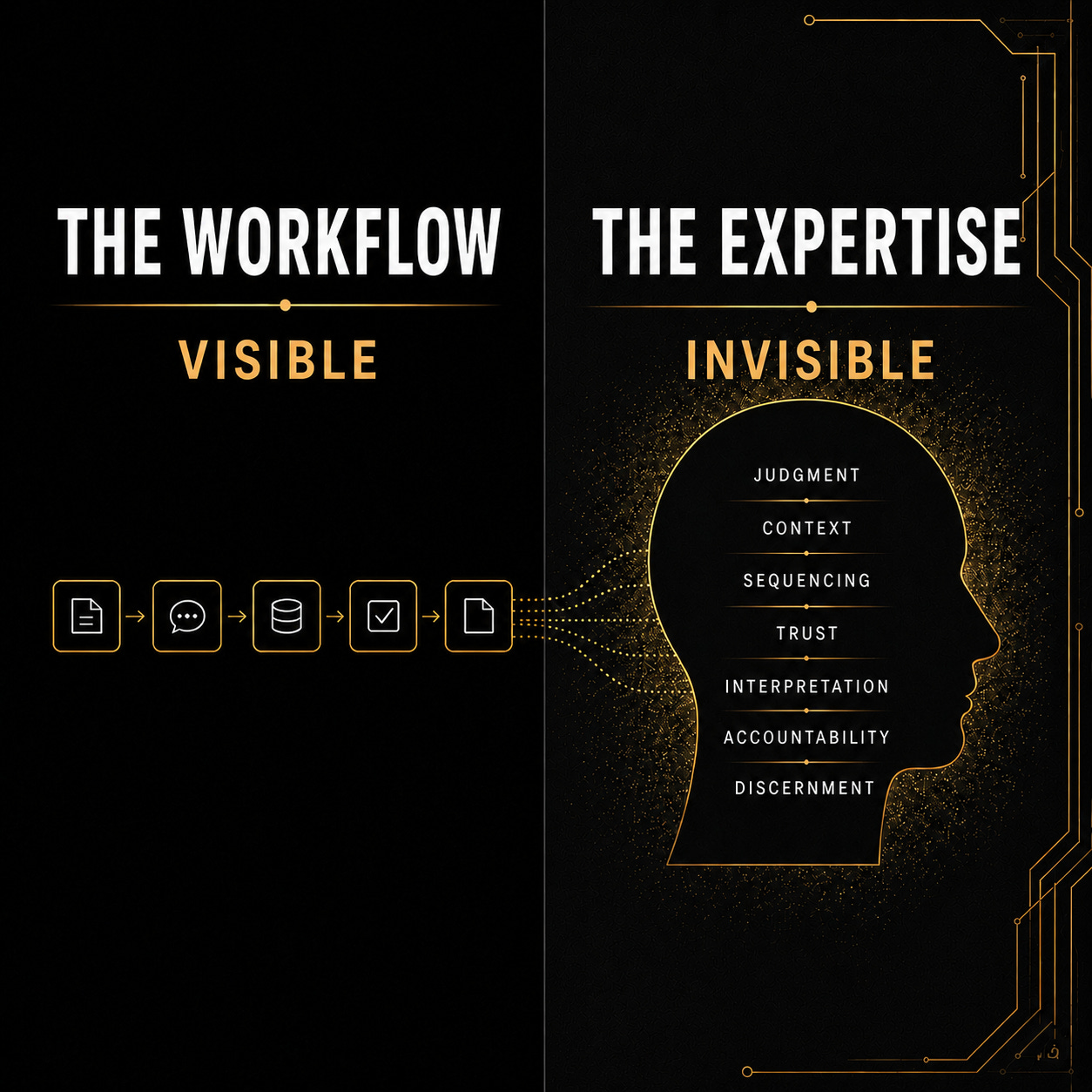
AI often looks right until an expert reads it
Imagine an AI tool summarizes a customer meeting.
The summary is clean. The action items are formatted. The tone is professional.
But the account lead reads it and immediately knows it missed the point.
Not because the AI failed to summarize the words.
Because it failed to understand what mattered.
It missed the customer hesitation. It missed the political sensitivity. It missed which action item was actually risky. It missed the difference between a routine follow-up and a signal that the deal may be in trouble.
The output is not weak only because the model is weak. It is weak because the model was given a shallow version of the work.
AI can produce polished work while missing the meaning.
Tacit knowledge is the hidden judgment inside domain expertise
Domain expertise is not just facts, terminology, or process knowledge.
It includes the judgment people build through experience.
Domain experts know what matters. They know what to ignore. They know what usually breaks. They know what good looks like. They know which exception is normal and which exception is dangerous.
That matters because AI can complete the visible task while missing the real standard of the work.
A model can follow instructions, use the right terminology, and format the output correctly while still missing the real standard of the work.
It may complete the task when the right move is escalation. It may summarize the meeting when the real issue is that no decision was made. It may draft the email while missing the relationship risk inside the message.
Tacit knowledge is the judgment layer that turns clean output into useful work.
The work is not the workflow
Organizations love workflows because workflows make work visible.
They show the steps. They clarify ownership. They create reporting structure. They make work governable.
That is useful.
But workflows are simplified stories.
They show how work is tracked, reported, and governed. They rarely capture the judgment required to make the work succeed.
The workflow says, “Send the follow-up.”
The expert knows whether that follow-up should be direct, careful, delayed, escalated, softened, or not sent at all.
The workflow says, “Create the proposal.”
The expert knows which assumption will get challenged, which proof point matters, which promise is too risky, and which stakeholder needs to be brought along before the proposal lands.
The workflow says, “Summarize the meeting.”
The expert knows the decision was not really made, the owner is not actually committed, and the next step is not a task. It is a sponsorship problem.
The work is not the workflow.
The workflow is the organization’s visible map. Domain experts supply the judgment that makes the map useful.
Generic prompts fail because they lack domain judgment
This is why pre-built generic prompts only get you so far.
They are useful starters:
summarize this
draft that
make this clearer
generate action items
create a plan
Those prompts can save time. They reduce blank-page friction. They make messy inputs easier to read.
But they usually operate at the surface level.
They do not know the domain-specific context, risks, quality standards, politics, customer signals, escalation rules, or stopping points.
Generic prompts create generic outputs. Domain expertise creates useful leverage.
Reverse prompting turns expertise into prompt workflows
The higher-value skill is not collecting generic prompt libraries.
It is learning how to use AI in reverse.
Instead of asking AI to complete the task immediately, ask it to help build the prompt, the prompt workflow, validation prompts, and escalation rules around the task or workflow.
Do not start with:
Write this for me.
Start with:
Help me design the prompt workflow for this recurring task.
That shift matters because the model can help pull tacit knowledge out of the expert’s head and turn it into something reusable.
One practical way to do this is to talk through the work out loud. Let the AI interview you. The goal is to surface the tacit knowledge you are already using but may not have written down.
A good reverse prompting process captures:
the recurring task
the context
what good looks like
what usually goes wrong
what the model should check
what the model should ask before proceeding
what the model should avoid
when the model should escalate
where human approval is required
Here is the reverse engineering prompt I would start with. If your AI tool has a reasoning or thinking mode, turn it on and give it room to work:
I have a recurring task I want to turn into a reusable AI workflow.
Help me reverse-prompt the workflow.
Start by interviewing me. Ask no more than 8 questions in the first round. Focus only on what you need to understand the task well enough to build a reliable workflow.
Cover:
What the task is
When and why it happens
What inputs the AI will receive
What the final output should look like
What excellent work looks like
What usually goes wrong
What the AI should check before finishing
When the AI should stop and escalate to a human
After I answer, turn my responses into a reusable workflow packet.
Include:
A plain-English workflow summary
The recommended number of prompts or steps
The final reusable prompt or prompt sequence
A reusable input template
A quality checklist
Guardrails and escalation rules
Any assumptions you made
Keep it as simple as possible.
Use the fewest steps needed to make the workflow reliable.
This is the practical high leverage move.
You are not treating AI as the expert. You are using AI to structure the expertise already inside your head.
The current generation of AI models is increasingly useful at interviewing domain experts, organizing their answers, and turning their judgment into reusable workflows.
The companies that win will scale tacit knowledge
The biggest AI opportunity is not automating more visible tasks.
It is turning hidden domain judgment into reusable organizational capability.
The work is not the workflow.
The workflow is only the visible map. Tacit knowledge is what tells you where the map is incomplete, where the risk is hiding, and when the next step should stop.
AI becomes reliable when that judgment is built into the workflow.
Without tacit knowledge, AI can follow the steps while missing the meaning.
With it, AI can help make expert judgment reusable, governed, and useful across real work.
Thanks for reading.
Subscribe for practical AI workflows, prompt systems, and governance patterns that make AI reliable enough for real work.