
A Simple Three-Step Process for Building Skills and Workflows with ChatGPT
How to separate thinking, planning, and execution so ChatGPT builds what you actually intended

Most people try to build an AI skill or workflow by jumping straight into execution.
They open a tool, write a large prompt, and hope the system understands what they are trying to accomplish.
That can work, but it usually forces you to solve two different problems at the same time:
Clarifying what you actually want
Figuring out how to build it
I have found it easier to separate those activities into three distinct steps.
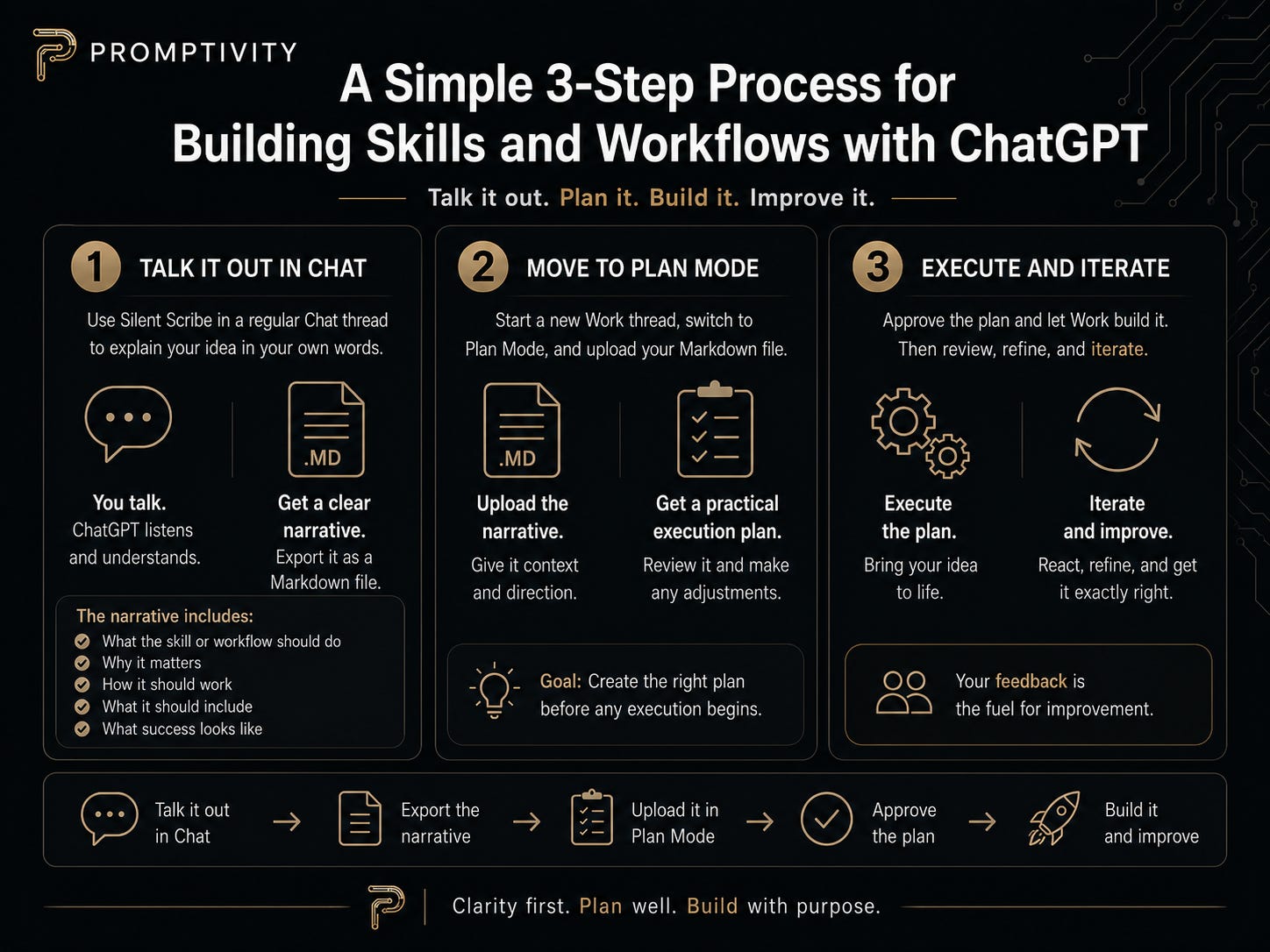
Step 1: Talk It Out in Chat
Start in a regular ChatGPT conversation and use a Silent Scribe approach.
Simple Silent Scribe Prompt
Act as a silent scribe while I think out loud.
Do not interrupt, advise, summarize, or ask questions. Capture my ideas, decisions, concerns, constraints, and desired outcomes.
When I say “Create the narrative,” turn everything I shared into a clear, structured design narrative in Markdown.
Preserve my intent, remove repetition, identify assumptions or unresolved questions, and do not invent missing details.
Instead of trying to write a perfect specification, explain the idea naturally. Describe the problem, the intended user, the desired outcome, your preferences, what has already been tried, and what you do not want.
The purpose of this first conversation is not to build anything.
It is to help ChatGPT understand the full context and turn your thinking into a clear narrative.
When the conversation is finished, ask ChatGPT to organize it into a Markdown document that explains:
What the skill or workflow should accomplish
Why it matters
How it should operate
What constraints it must respect
What success should look like
Export that narrative as a Markdown file.
Step 2: Move the Narrative into Plan Mode
Open a new Work thread, select Plan Mode, and upload the Markdown file.
Then use an instruction like this in /Plan Mode:
Read the uploaded narrative and create a practical execution plan for building this skill or workflow. Preserve the intent, preferences, constraints, and success criteria in the narrative. Do not begin execution yet.
This creates a clean handoff between thinking and building.
Chat helps you articulate the idea. Work turns the idea into an execution plan.
Review the plan before proceeding. This is the best point to catch incorrect assumptions, missing requirements, or unnecessary complexity.
It is much easier to correct the plan than to repair a poorly built workflow later.
Step 3: Execute and Iterate
Once the plan reflects what you intended, tell Work to execute it.
Then review the result and respond naturally.
Explain what works, what feels wrong, what should remain unchanged, and what is still missing. You do not need to rewrite the entire specification every time. Your judgment becomes the feedback loop.
The process is simple:
Talk it out → Export the narrative → Upload it in Plan Mode → Approve the plan → Build and improve
Start With Understanding, Not With Execution
The larger lesson is that good AI workflows do not begin with execution.
They begin with understanding.
Separate the narrative from the plan, and separate the plan from the build. That small change makes it much easier to create skills and workflows that reflect what you actually intended.
Want AI that works reliably in real work?
I write practical field notes on Governed Autopilot, AI workflows, prompt systems, and solo-operator leverage.
Subscribe free to get the next one.
You can also browse the full essay library here: promptivity.ai/essays
At my company, we write the narrative down as the outcome for our loops, which must be verified by an agent, a script, or a person that's completely independent from the loop. This keeps our original intent from disappearing into context rot.